Evaluating a workforce intelligence and AI skills management platform comes down to four questions: does it produce accurate, future-ready skills data; does it integrate cleanly with your existing HR stack; does it meet your compliance and AI governance requirements; and can it be deployed fast enough to deliver value before your role definitions change again. This guide gives HR leaders a structured framework for comparing platforms on these dimensions and choosing a solution that supports future-skills visibility without locking the organization into a long, expensive implementation.
What is a workforce intelligence and AI skills management platform?
A workforce intelligence and AI skills management platform is a software system that uses AI to map an organization's skills, infer capabilities from existing employee data, connect those skills to roles and opportunities, and provide forward-looking views of capability gaps. The platform sits between the HRIS, the learning system, and the talent processes that depend on skills data such as mobility, workforce planning, and reskilling.
Core functions:
- Continuous skills inference from resumes, project history, learning records, and performance data
- A maintained skills ontology that reflects current and emerging skills
- Role-to-skills mapping at the proficiency level
- Talent marketplace or internal mobility features
- Workforce planning views that show capability gaps against future needs
- Integration with the broader HR technology ecosystem
Why this evaluation framework matters
The evaluation matters because the cost of a wrong choice is high. A failed deployment burns 12 to 18 months, costs hundreds of thousands of euros, and leaves the organization further behind on skills strategy than when it started. The platforms in this category look similar in demos but diverge sharply on the dimensions that determine whether the data they produce will be trusted by HRBPs, managers, and employees in production use.
Gartner research on talent management trends underlines the urgency: HR leaders are being asked to pivot to skills-based talent strategies in a fast-changing market, and the quality of the underlying skills data is what makes or breaks that pivot.
The four-dimension evaluation framework
Dimension 1: Future-skills visibility capability
The point of these platforms is producing a forward-looking view of workforce capability, not just an inventory of current skills. Evaluate vendors on whether they can answer these questions:
- Which skills are emerging in our industry, and where do we currently stand?
- Which of our roles are most exposed to skills shifts in the next 18 to 24 months?
- Where are the adjacent skills that enable internal redeployment instead of external hiring?
- How does our skills profile compare to market benchmarks for similar organizations?
A vendor that only inventories current skills is solving half the problem. A vendor that produces forward-looking views with confidence levels and underlying evidence is solving the strategic problem. Data-driven HR transformation depends on this kind of predictive visibility, not on static skill inventories.
Questions to ask vendors:
- Show me a forward-looking capability view for a role similar to one of ours.
- How do you identify emerging skills before they show up in employee data?
- What evidence underpins your forward-looking views, and how is it validated?
Dimension 2: Compliance and AI governance
HR AI applications are classified as high-risk under the EU AI Act, which means specific requirements around transparency, human oversight, data quality, and documentation. Platforms operating in Europe must be compliant; platforms operating with European employees from outside Europe must also comply. The European Commission's draft guidelines on high-risk AI systems make clear that sourcing platforms, internal mobility tools, and performance analytics fall squarely in scope.
Beyond the EU AI Act, evaluate:
- GDPR posture for employee data, including data residency options
- Explainability features that let employees see why a skill was inferred
- Bias testing and mitigation for skills inference and matching
- Audit trails for HR decisions informed by the platform
- Data rights workflows for employee access, correction, and deletion
A platform that cannot produce documentation on these points is not enterprise-ready, regardless of how strong the rest of the product looks.
Questions to ask vendors:
- Walk me through your EU AI Act compliance documentation.
- How does an employee see and challenge an inferred skill?
- What is your data residency offering for European employee data?
Dimension 3: Integration readiness
A skills platform that does not integrate cleanly with your HRIS, LMS, ATS, and collaboration tools becomes another data silo. Integration readiness means more than having an API; it means having pre-built, supported connectors that handle the operational realities of enterprise data flows.
Evaluate:
- Pre-built connectors for your specific HRIS, LMS, and ATS
- Bidirectional sync, not just read-only data pulls
- Real-time or near-real-time updates for critical data flows
- Support for collaboration tools where skills evidence accumulates
- Single sign-on, role-based access control, and identity provider integration
Questions to ask vendors:
- Show me your integration with [your specific HRIS].
- How long does the standard integration take, and what does my team need to provide?
- What happens to inferred skills if an employee's HRIS record changes?
Dimension 4: Deployment speed and time-to-value
Historically, skills management deployments ran more than a year. Modern AI-native platforms deploy in weeks because the ontology is pre-built, inference works on existing data, and integrations are standardized. Long deployments are a category warning sign, not a sign of thoroughness.
Evaluate:
- Time from contract to first usable data
- Time to roll out across the full employee population
- Pre-built ontology versus custom-built taxonomy
- Required change management investment
- First-value milestones in the implementation plan
Questions to ask vendors:
- What is your typical deployment timeline for an organization our size?
- What does first value look like at 30, 60, and 90 days?
- How much of your ontology is pre-built versus custom-built for each client?
How to score vendors
Build a scorecard with the four dimensions, weighted by your specific priorities. A typical weighting for a global enterprise:
| Dimension | Weight |
| Future-skills visibility | 30% |
| Compliance and AI governance | 25% |
| Integration readiness | 25% |
| Deployment speed | 20% |
Score each vendor on each dimension from one to five, multiply by the weight, and sum. The exercise is less about the absolute score and more about forcing structured comparison instead of impression-based decisions.
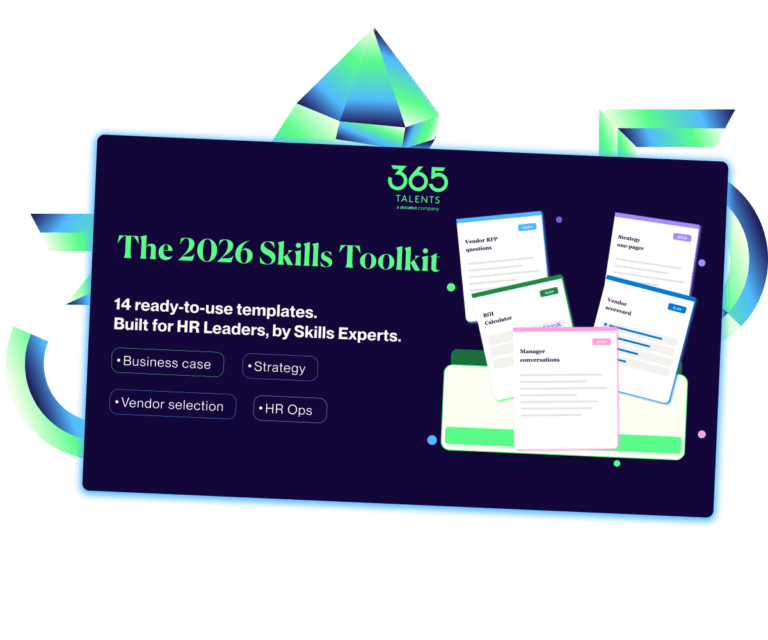
Building the business case for skills?
Inside the toolkit: ROI calculator, business case, budget justification, RFP questions, vendor scorecard, evaluation matrix, Strategy one-pager, governance model, performance reviews, career paths, mobility framework, Internal rollout plan.
Download the toolkit

Where multilingual capability fits in
Multilingual skills intelligence is a hard technical problem and a clear differentiator for global enterprises. If you operate across regions, multilingual support should be a gating criterion before vendors enter your scorecard. A platform that processes English well but degrades in French, German, or Spanish will produce uneven skills data across your workforce, which undermines every downstream use case.
365Talents is an example of a platform built around native multilingual skills intelligence across 55+ languages, with explainable AI and rapid deployment cycles that address several of the criteria in this framework.
Common evaluation mistakes
Three mistakes show up repeatedly in failed selections:
- Letting the demo drive the decision. Vendors demo with curated data. Insist on a proof of concept with your actual employee data before committing.
- Treating compliance as a checkbox. EU AI Act compliance is not a yes-or-no answer. Ask for the documentation and the specific evidence behind it.
- Optimizing for one use case. A platform chosen for mobility but weak on workforce planning will fail when the CHRO asks for a future-capability view.
What good looks like at the end of evaluation
A strong selection produces a platform that:
- Generates accurate skills data on your actual workforce within weeks of deployment
- Provides forward-looking capability views your CHRO can present to the executive committee
- Meets EU AI Act and GDPR requirements with documentation you can hand to legal
- Integrates with your HRIS, LMS, and ATS without requiring custom development
- Supports the languages your workforce actually operates in
Key takeaways
- Evaluate workforce intelligence and AI skills management platforms across four dimensions: future-skills visibility, compliance and AI governance, integration readiness, and deployment speed.
- The biggest predictor of deployment success is whether the ontology is pre-built and the inference engine works on existing data.
- EU AI Act compliance is now baseline, not differentiation. Vendors that cannot produce documentation are not ready.
- Multilingual support should be a gating criterion for global enterprises, not a scorecard line item.
- Use a weighted scorecard to force structured comparison, and always validate the demo with a proof of concept on your real data.
For a broader perspective on how AI and dynamic skills data are reshaping workforce readiness, see AI and Skills Data: The new foundation for workforce readiness.