TL;DR
Sixty percent of workers will require reskilling before 2027, according to the World Economic Forum. Yet most enterprise reskilling programs underdeliver because they are structured as content catalogs (more courses, more platforms, more LXP modules) rather than as capability systems. The fix is to operate reskilling as a business operating system: sense skill demand continuously, build capability through skills-based pathways, redeploy talent dynamically, and measure outcomes in capability gains, not course completions. This article maps the four shifts that separate effective enterprise reskilling from expensive learning theater.
Introduction
You can spot a struggling enterprise reskilling program by its dashboard. Course completion rates are climbing. Learner satisfaction is strong. Investment in the LXP is going up. Yet 18 months in, the CHRO cannot answer the only question that matters to the CEO: "Have we actually built the capability we said we would build?"
The dashboards measure activity. The CEO is asking about outcomes. And the two have decoupled.
This is the central failure mode of enterprise reskilling in 2026. The scale of the challenge is genuine: the World Economic Forum reports that 60% of workers will require training before 2027, and that 44% of workers' skills will be disrupted within five years. The investment is being made: the global L&D market continues to grow at double digits. But the translation from investment to enterprise capability is stalling.
The reason is structural. Most enterprise reskilling programs are designed as catalogs of learning content, when they need to be designed as business operating systems for capability. This article explains the difference, identifies the four shifts that separate the two, and shows how a skills-based approach makes the operating-system model achievable at enterprise scale.
Why reskilling at scale keeps failing
Because reskilling is being managed as a content problem when it is actually a system problem. Adding more courses, more platforms, and more learning content cannot solve a problem that originates upstream in how skill demand is sensed, how capability gaps are identified, and how learning translates into deployed talent.
Three failure patterns recur across enterprise reskilling programs.
Activity-over-outcome metrics. Course completion rates are easy to measure. Capability gains are not. So programs are managed against the easy metrics, and the hard metrics quietly drift. After 18 months, the program looks successful on the dashboard and feels ineffective in the business.
Catalog inflation without targeting. Enterprise L&D teams are under pressure to demonstrate value, so they keep adding content. More vendors, more libraries, more learning paths. The catalog grows; learner attention does not. The result is a vast library that no one navigates and no one uses to build a coherent capability.
The bring-your-own-AI shadow. TMI's 2026 research reports that 78% of AI users bring their own AI tools to work, bypassing enterprise learning standards. Employees are reskilling themselves on ChatGPT, Claude, and Copilot faster than corporate L&D can curate content about them. The official program is being lapped by the shadow program.
These three patterns share a root cause: the program treats reskilling as a content distribution problem instead of an enterprise capability problem.

The four shifts from catalog to operating system
The organizations that are translating reskilling investment into capability share a specific pattern. They have made four shifts in how they design and run their programs.
Shift 1: From course catalog to capability roadmap
A catalog answers the question "what learning content do we have?" A capability roadmap answers the question "what skills do we need, by when, and for which roles?" The two artifacts look superficially similar but drive completely different behavior.
A capability roadmap is built backward from business strategy. It identifies the critical capabilities the organization needs to develop in the next 18-36 months (AI fluency in finance, data analysis in operations, sustainability expertise in procurement). It quantifies the gap between current and target capability levels by role and function. And it sequences development efforts against business milestones, not learning calendar cycles.
This is what TMI calls "strategy-to-skills translation": the why and where of reskilling, made explicit before any content decision is made.
Shift 2: From self-declared skills to AI-inferred skills
You cannot reskill what you cannot see. Most enterprise reskilling programs are flying blind because the underlying skills data is poor: outdated job descriptions, optional self-assessment surveys with low completion rates, and HRIS records that capture roles but not capabilities.
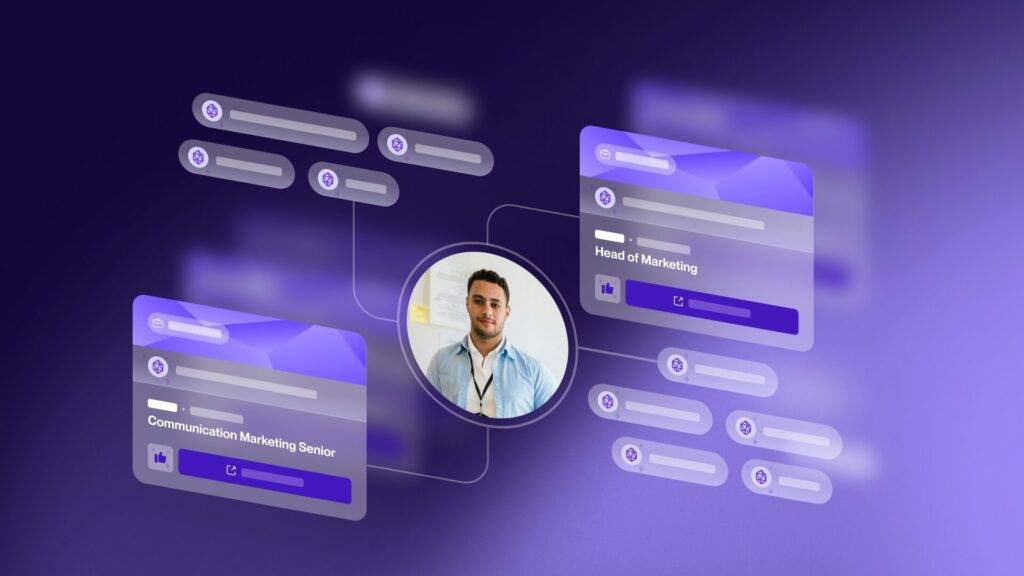
The shift is to AI-inferred skills, drawn from existing HR data (resumes, performance reviews, completed projects, training history, internal communications) without requiring employees to fill out surveys. This is the foundation of a skills graph that connects people to opportunities and makes the entire reskilling program operable on real data.
Without this shift, the capability roadmap is built on guesses. With it, the roadmap is built on facts.
Shift 3: From learning completion to capability deployment
The metric of a reskilling program is not how many courses people completed. It is whether the newly developed capability is being deployed in real work. Without deployment, the learning is wasted.
This is the shift that exposes most reskilling programs as theater. An employee who completes a 40-hour AI course and never applies the skill to their actual work has not been reskilled in any operational sense. The course completion was a transaction; the reskilling was not.
Organizations that take this shift seriously connect their reskilling program to their internal mobility program. New capabilities trigger new opportunities. Employees who acquire a target skill are surfaced for projects, gigs, or roles that use that skill. The reskilling loop closes: learn, apply, deploy, measure, iterate.
This is why reskilling at scale is inseparable from internal mobility infrastructure. One without the other produces dashboards without outcomes.
Shift 4: From annual planning to continuous sensing
Skills demand is changing faster than annual planning cycles can handle. A 2024 reskilling plan written against the AI landscape of 2024 is partially obsolete by 2026. Annual updates cannot keep pace.
The shift is to continuous sensing: an always-on capability that detects emerging skill demand from internal signals (new projects, new technologies adopted, role evolution) and external signals (industry benchmarks, labor market data, AI capability releases). The capability roadmap is updated continuously, not annually. New priorities are added; deprecated priorities are removed.
This requires skills intelligence infrastructure, not just analytics dashboards. The four shifts together describe what an enterprise capability operating system actually looks like.
What a capability operating system delivers
When the four shifts are made together (catalog to roadmap, declared to inferred, completion to deployment, annual to continuous), the reskilling program stops looking like an L&D function and starts looking like a business operating system.
Three operational outcomes follow.
Capability gains are measurable in business terms. "We have reduced our AI fluency gap in the finance function from 65% to 22% over 18 months, against a 15% target by month 24." That is a sentence that can be said to a CEO.
Investment is targeted, not sprayed. Learning budget is allocated to the capability gaps that matter most, in the populations where the gap is largest, with the most direct path to deployment. Catalogs shrink; targeted pathways grow.
The shadow AI program comes back into the daylight. When the official program is faster, more targeted, and more relevant than what employees can find on their own, the shadow program shrinks. Bring-your-own-AI does not disappear, but it complements rather than replaces the official capability strategy.
How to start: a 90-day capability sprint
Most enterprise reskilling programs were designed years ago, when the underlying skill data, AI inference capabilities, and integration infrastructure looked very different. Rebuilding the entire program is rarely feasible. A 90-day capability sprint is a more practical entry point.
Days 1-30: Activate skills visibility. Deploy a skills intelligence layer that infers capabilities from existing HR data. The goal is to produce a current-state map of the workforce skills, by function, by population, by criticality. No employee survey required. This is what tools like 365Talents Skills View are designed to deliver.
Days 31-60: Build the capability roadmap. With the current-state map in hand, work with business leaders to identify the 5-10 critical capabilities the organization needs to build in the next 18-24 months. Quantify the gap between current and target. Sequence priorities against business milestones.
Days 61-90: Connect learning to deployment. For each priority capability, map the learning pathways that build it AND the internal opportunities that deploy it. Connect the L&D platform to the internal talent marketplace. Make completion trigger opportunity surfacing.
At the end of 90 days, you have replaced a fragmented catalog with a working capability operating system at small scale. From there, you expand.
Conclusion
Reskilling at scale is not a content problem. It is a system problem. The organizations that are succeeding have stopped treating their L&D function as a course distribution center and started treating it as a capability operating system, with skills intelligence as the foundation.
The four shifts (catalog to roadmap, declared to inferred, completion to deployment, annual to continuous) are not optional refinements. They are the difference between a program that produces dashboards and a program that produces capability. The companies making these shifts will be the ones answering the CEO's question in 18 months with data, not slides.
Start with a working skills map, not another platform RFP
The 90-day capability sprint described above starts with skills visibility. 365Talents Skills View delivers that visibility in weeks, by activating the skills data already sitting in your HRIS, ATS, and LMS. No employee survey campaign. No multi-year deployment. Just the current-state capability map you need before any other reskilling decision can be made properly.
→ Get the Skills View guide to see how the activation works and what the outputs look like for organizations at your scale.
Already running a reskilling program that's plateauing?
Talk to a 365Talents expert for a structured diagnostic of where the system is leaking.
Talk to our experts

FAQ
What is reskilling at scale?
Reskilling at scale is the systematic development of new capabilities across a large workforce, typically thousands to tens of thousands of employees, to match evolving business needs. It differs from individual upskilling in that it requires enterprise infrastructure: skills intelligence, capability roadmaps, learning pathways, and deployment mechanisms working together as a system.
Why do most enterprise reskilling programs fail?
Because they are structured as content catalogs (course libraries, LXP modules, vendor partnerships) when they need to be structured as capability operating systems. Activity metrics like course completions look good on dashboards but do not translate into deployed business capability. The gap between learning investment and enterprise outcomes widens over time.
How do you measure the ROI of reskilling?
By measuring capability gains and deployment rather than course completions. Practical metrics include the percentage reduction in critical skill gaps over time, the rate at which newly developed skills are deployed in real projects, internal mobility rate into target roles, and time-to-productivity for reskilled employees compared to external hires.
What is the role of AI in reskilling at scale?
AI plays two distinct roles. First, AI infers employee skills from existing HR data without requiring surveys, making the entire reskilling system operable on real data. Second, AI personalizes learning pathways and matches reskilled employees to deployment opportunities. Without AI infrastructure, reskilling at enterprise scale is operationally impossible because the manual coordination cost is prohibitive.
How long does it take to build a reskilling program?
A working capability sprint can be launched in 90 days with the right infrastructure. Full enterprise transformation typically takes 18-24 months. The variable is not the technology, which deploys quickly, but the change management and integration with business operations.
How does reskilling connect to internal mobility?
Closely. A reskilling program that does not connect to internal mobility produces learning without deployment. The new capability is built but never used, which is the most common failure mode. Effective programs make completion of reskilling pathways trigger opportunity surfacing through an internal talent marketplace.
Do we need to replace our LMS to build a capability operating system?
No. The LMS continues to deliver learning content. The capability operating system adds three layers around it: skills intelligence (what capabilities exist and which are needed), capability roadmaps (what to build, by when), and deployment mechanisms (internal mobility, project staffing). The LMS becomes a component of the system, not the entire system.