Succession planning for critical technical roles is one of the most pressing workforce planning challenges in industrial organizations. The workforce is large, distributed, and primarily non-desk. And the talent marketplace tools designed to solve the problem often make it worse.
Talent marketplaces, self-service portals, and internal gig platforms were built for office-based employees. When deployed to frontline populations, they consistently stall to gain traction. Technicians do not browse internal job boards between shifts, and operators do not update skill profiles on their breaks.
The result: HR launches a succession planning initiative, only to find that the people who matter most never participate.
Beyond engagement, it is a design problem.
Real case: mapping 3,000 technicians for succession planning without a single login
A global industrial organization was facing exactly this succession planning challenge. Previous attempts to deploy a talent marketplace had failed among the technician population, as HR lacked visibility into three critical questions: Who could step into critical roles? Where did internal mobility opportunities exist? Which skills were at risk of being lost?
The organization chose a fundamentally different path. Instead of asking employees to participate in a new talent marketplace, they activated the skills data already sitting in their HRIS.
Using AI-powered skills detection, the organization mapped competencies across more than 3,000 technicians. The source material? Job histories, training records, and certifications already captured in their existing HRIS systems. No employee was asked to log in. No new tool was deployed to the frontline. This is 365Talents’ Skills View power.
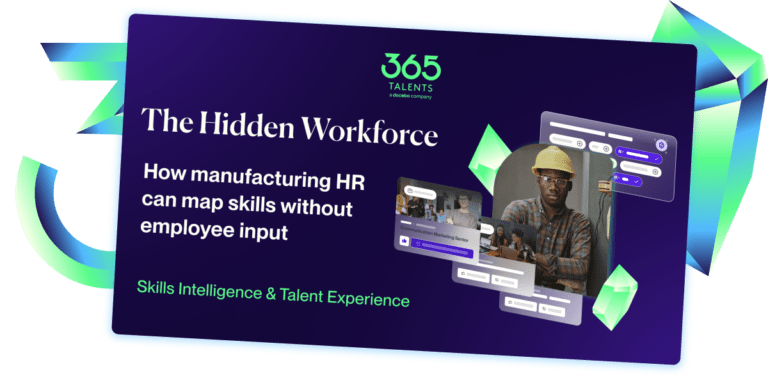


Skills-based succession planning outputs in weeks with Skills View
Within weeks, HR and operational leaders had access to a set of concrete, actionable succession planning outputs.
A structured skills taxonomy and job architecture built from the organization’s own HRIS data and enriched with industry benchmarks. This was not a generic framework imposed from outside. It reflected the actual reality of how roles and competencies were distributed across sites.
Succession planning views with ready-now and future successors for critical roles across sites. For the first time, HR could see not only who was next in line for a role, but also who could be ready in six months with targeted development and reskilling.
Skills gap analysis at individual, team, and global levels. Shortages and redundancies surfaced across the organization. Some skills gaps had been known intuitively but never quantified. Others were entirely new to HR leadership.
Actionable internal mobility recommendations to bridge skills gaps through internal mobility, reskilling, or targeted hiring. Instead of debating options in the abstract, leadership could evaluate scenarios against real skills data.
Guided internal mobility: an alternative approach
What makes the 365Talents approach distinct is how internal mobility decisions are handled. There is no talent marketplace. There is no self-service portal for employees to browse.
Instead, HR and managers retain full control over the succession planning process. They identify internal mobility candidates based on skills data. They guide career moves and succession decisions using structured evidence rather than relying on who raises their hand or who happens to be most visible.
Skills View helps you to get guided mobility: targeted, governed by HR, and grounded in skills intelligence data.
The organization piloted internal mobility in a controlled way, focusing on critical populations rather than attempting a full-scale talent marketplace rollout. This reduced risk, accelerated time-to-value, and gave leadership confidence that succession planning decisions were based on verified skills rather than assumptions or seniority.
Why AI-powered succession planning worked where talent marketplaces stalled
No dependency on employee input. The entire succession planning process was HR-controlled. There was no adoption curve, no training campaign, no engagement funnel to manage.
Speed. Because the approach relied on existing HRIS data, succession planning results were available in weeks, not months. Planning that had been stalled became operational within the first quarter.
Precision across languages and geographies. Skills were extracted and structured using AI, then mapped to a unified skills taxonomy that worked across 55+ languages. The platform handled translation and normalization automatically.

Key takeaway: succession planning starts with skills visibility
Succession planning does not require a talent marketplace. It does not require employees to log in, fill out profiles, or browse internal opportunities.
What it requires is skills visibility. And that visibility can come entirely from HRIS data you already have, activated through AI-powered skills mapping.
If your succession planning is stalled because your frontline workforce will not engage with digital tools, the answer is not to push harder on adoption. The answer is to remove the dependency entirely.