Skills management is an essential strategic approach for modern skills-based organizations putting their people at the heart of HR. It focuses on identifying, developing, assessing and implementing the skills needed to achieve organizational and individual objectives.
This practice maximizes employees' potential while strengthening the company's overall competitiveness.
In this article, we'll explore the definition, key objectives and strategies for effective skills management.
What is skills management?
Skills management is a process that aims to identify, assess, develop and align employee skills with corporate objectives.
It goes beyond the simple assessment of qualifications and experience, and includes people's behavioral, technical and interpersonal skills. The ultimate aim is to ensure visibility, in turn ensuring that every employee has the skills required to successfully accomplish the tasks assigned to them, in line with the company's overall strategy.
Objectives of skills management
Skills management is based on knowledge of all the company's skills. This includes:
- Knowledge: Your employees all have knowledge. This is the theoretical knowledge acquired by an employee through education or training. It forms the basis for developing technical skills.
- Hard skills: Throughout their career, employees acquire technical skills, or hard skills. These are all the skills needed to do a job, or professional practice.
- Soft skills: Soft skills are related person's overall behavior and refer to how the interact with colleagues, solve problems and manage work.
Knowing your people's skills enables organizations to meet specific objectives, including:
Evaluating skills:
A company that wants to put its employees first must value them. To do so, it needs to help them develop and adapt to the ever-changing job market. Skills assessment is therefore crucial to identifying the level of expertise within each employee, and enabling them to play an active role in their professional development and progression.
Anticipating skills needs:
By assessing and analyzing current skills, you can compare them with those prevalent in the market and reduce skills gaps. By anticipating future needs, the company can prepare for market and technological changes, ensuring greater agility in the face of future challenges and anticipating future gaps.
Optimizing individual and collective performance:
By assessing and enhancing the skills of each employee, the company can improve the overall performance of its teams. A better match between the skills of each individual and the tasks to be accomplished promotes greater productivity and a higher quality of work. Of course, if your teams perform better, the company's overall results will only improve.
Strengthening employee engagement and motivation:
When employees see that their skills are valued and that they receive opportunities for professional development, their engagement and motivation are strengthened. This leads to higher retention of talent within the company.
Facilitating talent management:
Talent management helps to identify potential talent and develop them with a view to preparing them for higher leadership and responsibility roles within the organization. It is therefore an indispensable aid to facilitating, improving and optimizing your talent management strategy.
Strengthening your employer brand:
A company that invests in developing the skills of its employees attracts more talent and strengthens its reputation as an attractive employer. What more could you want for future recruitment?

What are the benefits of skills management?
Skills management offers benefits for the whole company. By whole company, of course, we mean your employees, your management and your HR department.
More precisely, skills management enables HR to:
- Optimize recruitment
- Staff projects precisely
- Define training needs in order to offer appropriate training to the right candidates
- Evaluate the level of expertise of your teams in order to stay up to date with the expected level of the market and not fall behind the competition
- Propose adapted remuneration and compensation policy
- Monitor and track development of critical skills
Globally, for the company this means:
- Improved talent management
- Improved collaborative learning and collective intelligence
- Happier employees
- Happier leadership
Let’s dive into these benefits in detail.
Improved talent management
This includes both talent identification and talent retention.
Effective talent management enables you to identify internal or external talent that will perform to improve results. You'll be able to find the right skills for existing internal positions, as well as develop the existing or new skills of loyal employees.
It also allows you to offer appropriate training and professional developmenttraining and professional development to each of your employees. An employee who has opportunities for advancement will be more motivated and committed, which in turn will increase their loyalty. And that's no mean feat in today's war for talent!
Improved collaborative learning and collective intelligence
Skills management is a way of exchanging skills between peers. New talents have much to contribute, just as existing employees can train them. This sharing and collaboration enables collective learning and cultivates collective intelligence and communities of experts.
Happier employees
Your employees feel valued, which will motivate them in their work. They can showcase their abilities, develop their skills and enhance their employability.
They are naturally more fulfilled when they feel listened to, put forward and more competent.
Happier leadership
For a company, the use of these talents and skills must be in line with its strategic objectives. Optimized skills management therefore makes it possible to:
- Reduce recruitment costs
- Give visibility to the company's talents
- Promote flexibility and adaptation
- Strengthen collective intelligence
- Stay ahead of the competition
Skills management is an essential component of modern, agile human resources management. By investing in the skills development of its employees, a company can improve its overall performance, strengthen its competitive edge and create a culture of continuous learning.
With the right skills management strategy in place, a company can attract, retain and develop the talent needed to succeed in an ever-changing business environment.
Ready to discover a more efficient and effective skills management methodology? Reach out to the 365Talents team today and chart a new course for people at work.
Skills management strategies
In a world where roles evolve faster than job descriptions can keep up, thriving organizations are shifting from a job‑first mindset to a skills‑first strategy. Instead of focusing solely on titles and static org charts, HR leaders are asking a more powerful question: What skills do we have, and what skills do we need to grow?
A skills‑first approach to workforce planning empowers companies to see beyond traditional silos, uncover untapped potential, and deploy talent where it creates the most impact. By building a clear skills framework, leveraging AI‑powered skills intelligence platforms, and embedding skills data into everyday decisions, organizations can unlock agility, drive employee engagement and retention, and prepare their people for what’s next. The following strategies outline how to bring this vision to life—step by step.
5 steps to implementing skills management in organizations
Embedding skills management in your organization starts with rethinking how you view talent—moving beyond static job descriptions to dynamic, real‑time skill profiles. Begin by defining a clear skills taxonomy that captures current and emerging competencies and aligns them with business priorities.
HR leaders should collaborate with business units to identify critical skills, align them with strategic objectives, and create a central skills database. From there, AI‑driven platforms like 365Talents can automate skill detection through self‑declarations, manager validations, and continuous feedback loops.
1. Build a clear skills taxonomy
Create a living, breathing framework of all the skills your organization needs today and tomorrow.
- Map core skills, emerging skills, and adjacent skills.
- Align them with business objectives and future workforce planning.
- Keep it dynamic: refresh your taxonomy as new projects and technologies appear.
2. Centralize skills data for visibility
Bring all skills information into one place—a skills intelligence platform or AI‑powered talent marketplace.
- Consolidate employee profiles, learning records, and project histories.
- Enable real‑time visibility so managers and employees can make informed decisions.
3. Integrate skills into workforce planning
Shift from job-based to skills-based planning:
- Match projects and roles to skill sets, not just titles.
- Proactively identify skill gaps and plan reskilling and upskilling initiatives.
- Use predictive analytics to forecast future needs.
4. Connect skills to career growth
Turn skills data into opportunities:
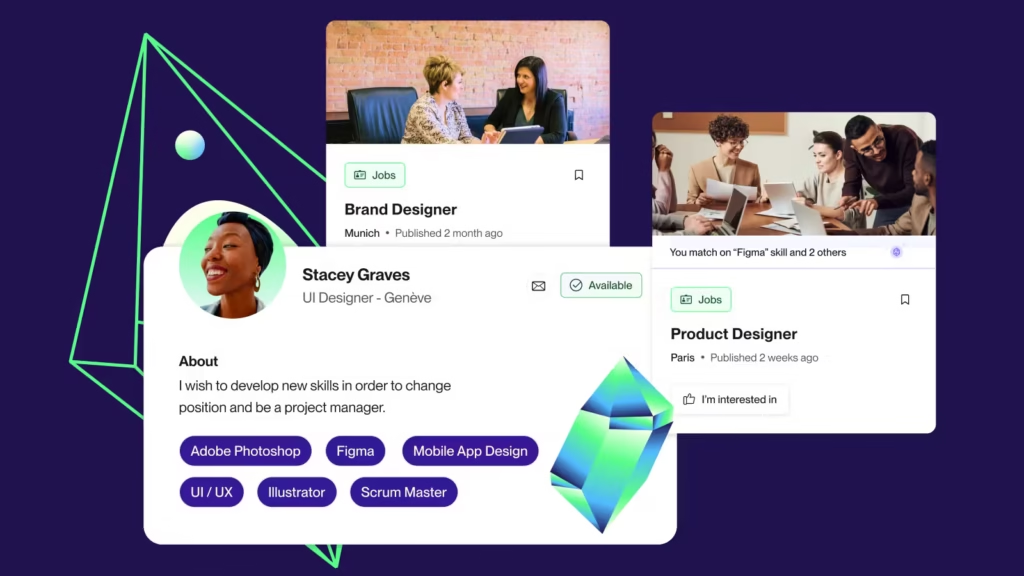
- Offer internal mobility by surfacing hidden talent for open roles.
- Provide personalized learning recommendations tied to skill gaps.
- Show employees a transparent path for advancement—fueling engagement and retention.
5. Foster a Skills-First culture
Embed skills management into daily processes and conversations:
- Encourage employees to self‑declare and update their skills regularly.
- Train managers to discuss skills in one‑on‑ones and performance reviews.
- Celebrate skill development milestones publicly to drive adoption.
Tools and technologies for skills management
The right technology stack is the backbone of modern skills management. Today’s leading companies rely on AI‑powered talent marketplaces, integrated learning management systems, and skills intelligence platforms to map, track, and evolve their workforce capabilities.
Platforms like 365Talents deliver real‑time skills visibility by analyzing employee profiles, project histories, and learning data. Coupled with analytics dashboards and integrations with HRIS and ATS systems, these tools allow HR teams to forecast skills gaps, recommend personalized learning pathways, and surface internal candidates for open roles.
By leveraging these technologies, organizations not only simplify administrative tasks but also gain a competitive edge by anticipating future skill needs.
Best practices for effective skills implementation
To ensure lasting impact, leading HR teams follow a set of proven best practices:
- Start small, scale fast: Pilot your skills framework in a single department before expanding.
- Promote transparency: Encourage employees to update their profiles and make skills data visible across teams.
- Link skills to opportunities: Use your skills intelligence to fuel internal mobility, career mapping, and succession planning.
- Continuously refresh your taxonomy: Market trends evolve quickly—keep your skills framework updated to stay future‑ready.
- Champion a skills‑first culture: Communicate often, celebrate skill development wins, and train managers to have skills‑based conversations with their teams.

Why choose 365Talents for your skills management tool?
When it comes to building a skills‑based organization, you need more than a database of skills and jobs—you need a platform that turns skills data into action. That’s where 365Talents stands apart. Our AI‑powered skills intelligence platform goes beyond static job descriptions to give you real‑time visibility into the skills you have and the skills you need. It automatically surfaces untapped talent, maps skill adjacencies, and recommends growth opportunities tailored to each employee.
Key features of 365Talents
- Close skills gaps faster with data‑driven insights and predictive analytics.
- Boost internal mobility by matching people to projects, missions, and roles they’re truly ready for.
- Drive engagement and retention by empowering employees to own their development journeys.
- Integrate seamlessly with your existing HR ecosystem, from HRIS to learning platforms.
Choosing 365Talents means choosing a partner that puts skills at the center of your talent strategy, giving you the agility to anticipate change, the visibility to mobilize talent, and the tools to unlock a truly future‑ready workforce.
How we build your skills ontology and framework: The Tetris game
365Talents helps you to create a unique, accurate, and concise skills framework that aligns with your organization's specific skills context and culture. The framework is designed to be accurate, tailored to the specific abilities of your employees, and constantly updated to meet HR use cases and stay in sync with the latest trends. It is also designed to be dynamic, operating seamlessly within the flow of work, making it an invaluable tool for HR professionals. Most importantly, skills data should be accessible to all other HR processes and systems, serving as a common language for Talent Management and Talent Experience.
To achieve these objectives effectively, we use both top-down and bottom-up approaches to help you build a specific skills framework. Imagine your skills framework like a Tetris game board.
Your framework is a fusion of various sources that, through smart and strategic interpretation and manipulation, can be fit together for a seamless, rock-solid view of your company’s current skills.
No matter the shape, size or quantity of the skills data you currently have, we can integrate additional data or complement it with our existing frameworks, filling in any gaps you might have and mirroring your historical approach.
Once everything is live, you have your centralized and dynamic skills framework. Our technology takes over, performing automatic categorization, synonym detection, semantic matching, language detection, and automatic translation.

Measuring success in skills management
Adopting a skills-first approach is only the beginning—measuring its impact is what transforms it from strategy to success. As organizations invest in skills management to boost agility, drive internal mobility, and future-proof their workforce, HR leaders must be able to show real, measurable outcomes. Are we closing critical skills gaps? Are employees more engaged in their development? Are we reducing time-to-fill through better talent visibility?
Tracking the right metrics helps answer these questions and connects your skills initiatives directly to business value. Whether through advanced skills data analytics, internal mobility KPIs, or employee engagement trends, measuring success ensures your skills-first strategy is not only working—but evolving. In this section, we explore the key performance indicators to monitor, and real-world success stories that prove the power of skills-based transformation in action.
Key Performance Indicators (KPIs)
To truly measure the ROI of skills management, organizations need clear KPIs that connect skills initiatives to business outcomes. High‑performing HR teams track metrics such as:
- Skills coverage: Percentage of critical skills identified and validated across the workforce.
- Internal mobility rate: How often employees transition to new roles or projects internally.
- Learning adoption and completion: Engagement with upskilling programs tied to targeted skill gaps.
- Time to fill open roles: Reduction in hiring lead time due to internal sourcing.
- Retention and engagement scores: Direct impact of visible career paths and growth opportunities.
These KPIs not only demonstrate impact to leadership but also guide iterative improvements in your skills management strategy.
Case studies and success stories
Across industries, organizations that adopt a skills‑first approach are already seeing measurable results.
- Global Manufacturing Leader: By implementing 365Talents’ AI‑powered platform, the company mapped over 15,000 employee skills in six months, reducing external hiring by 20% and saving millions in recruitment costs.
- Financial Services Firm: After introducing an internal talent marketplace, they saw a 35% increase in internal mobility and identified previously untapped talent for key digital transformation projects.
- Tech Scale‑Up: Using real‑time skills data to fuel learning pathways, the company closed critical skill gaps in cybersecurity within a year, positioning itself ahead of regulatory changes.

Discover 365Talents' Skills Management Guide
Read on and discover the power of skills management and how 365Talents can empower your organization to reach success.
Dowload How-to-guide