
The leading AI skills management tools for mapping workforce capabilities are platforms that combine an AI-driven skills ontology, automated skills inference from employee data, role-to-skills mapping, and integrations with the HRIS and learning systems. The strongest tools share three traits: responsible and explainable AI, fast deployment cycles measured in weeks rather than quarters, and multilingual skills intelligence that works natively across the languages an enterprise operates in.
This guide walks through the categories of AI skills management tools, what makes a tool actually "AI-driven" rather than AI-labeled, and how to evaluate options without getting lost in feature checklists.
What is an AI skills management tool?
An AI skills management tool is software that uses machine learning to detect, infer, validate, and continuously update the skills present in a workforce, then maps those skills to roles, opportunities, and learning paths. The AI component matters because manual skills tagging at enterprise scale is impossible. With thousands of employees and tens of thousands of possible skills, only inference at scale produces a usable map of workforce capabilities.
The capabilities that define this category:
- Automatic skills inference from resumes, profiles, project history, and performance data
- A structured skills ontology that updates as the market and the organization evolve
- Confidence scoring and validation workflows so inferred skills can be confirmed
- Multilingual processing, since enterprises rarely operate in one language
- Integration with HRIS, ATS, LMS, and talent marketplace systems
- Explainability features that show why the system inferred a given skill
Why "AI skills management" is now a distinct category
This category exists because traditional competency management collapsed under its own weight. Competency frameworks built in 2018 cannot keep up with roles where AI tooling, hybrid collaboration, and rapidly evolving technical stacks change task composition every quarter. AI skills management tools emerged to solve the maintenance problem: instead of asking HR to update a framework manually, the system infers and updates skills automatically from the work people are already doing.
According to industry analysts, skills-based workforce strategies are now a stated priority for the majority of large enterprises, but adoption is bottlenecked by the lack of accurate, continuously maintained skills data. AI skills management tools are the layer that unblocks this.
Categories of AI skills management platforms
1. AI-native workforce intelligence platforms
These platforms were built from the ground up around an AI skills ontology. They typically offer the deepest inference capabilities, the freshest ontologies, and the strongest multilingual support, because skills intelligence is their entire product rather than a feature.
Typical strengths: ontology depth and freshness, inference accuracy, multilingual coverage, fast deployment, responsible AI design. 365Talents falls in this category, with a focus on multilingual skills intelligence, explainable AI, and deployment timelines measured in weeks.
Best fit for: enterprises where skills data quality is the strategic priority and the ontology will drive multiple HR processes.
2. Talent marketplace platforms with AI skills layers
Talent marketplaces have added AI skills inference to power their internal mobility matching. The skills layer is real, but its primary purpose is fueling the marketplace rather than serving as an enterprise-wide skills system of record.
Typical strengths: opportunity matching, employee experience, gig and project staffing. Typical weaknesses: skills data may not be exposed as cleanly for other HR processes such as workforce planning or compensation.
Best fit for: organizations whose primary use case is internal mobility rather than enterprise skills strategy.
3. HRIS-embedded AI skills modules
Major HRIS suites have added AI skills capabilities as native modules. The advantage is unified data and a single vendor relationship; the trade-off is usually a less mature ontology and slower innovation than dedicated specialists.
Typical strengths: native integration, simplified procurement, unified user experience. Typical weaknesses: ontology depth, multilingual nuance, AI explainability.
Best fit for: organizations already standardized on a single HR suite that prioritize integration over best-of-breed AI capability.
4. Learning platforms with AI skills inference
Learning experience platforms have added AI skills mapping to connect learning activity to skill development. They are strong at the learning-to-skill connection but typically lighter on the broader workforce capability mapping side.
Typical strengths: learning-to-skills loop, development planning, content recommendation. Typical weaknesses: less depth on role-to-skill architecture and workforce planning use cases.
Best fit for: organizations where L&D owns the skills agenda and learning is the primary lever.
5. Recruiting and ATS platforms with skills extraction
Some ATS platforms have added skills extraction to improve candidate matching. These tools handle external hiring well but rarely extend cleanly to the internal workforce capability mapping problem.
Typical strengths: candidate skills extraction, external hiring workflows. Typical weaknesses: limited reach beyond the recruitment process.
Best fit for: talent acquisition teams whose primary need is candidate matching.
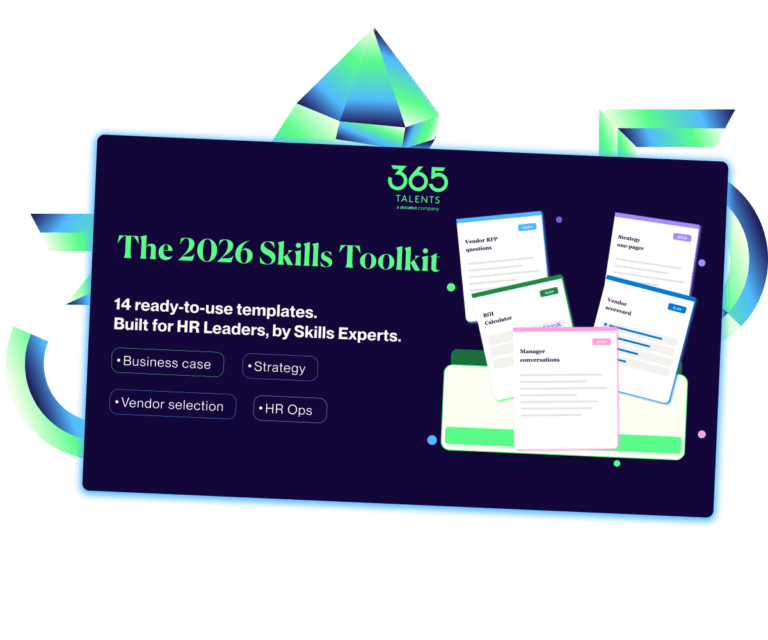
Discover which tool fits you best
Evaluate all skills management solutions with 14 ready-to-use templates!
Download

How to evaluate AI skills management tools
Three dimensions separate strong tools from labeled-as-AI tools:
Responsible and explainable AI
The system should show why it inferred a given skill, expose confidence scores, allow employees to validate or reject inferences, and document how the underlying models are trained. EU AI Act compliance is now table stakes for European operations, and the bar will only rise. Ask vendors how their AI handles the high-risk classification that applies to HR use cases.
Deployment speed
Skills management deployments historically ran 12 to 18 months, which is incompatible with how fast roles are changing. Modern AI-native platforms deploy in weeks because the ontology is pre-built and the inference engine works on data the company already has. If a vendor's deployment plan starts with a six-month taxonomy-building project, that is a category warning sign.
Multilingual skills intelligence
A workforce that operates in English, French, German, Spanish, and Mandarin needs a system that understands skills in all five languages natively, not through translation layers that lose nuance. This is one of the hardest technical problems in the category, and one of the clearest separators between platforms built for global enterprises and platforms built for single-region use.
Find out more AI skills management evaluation criteria in our dedicated guide!
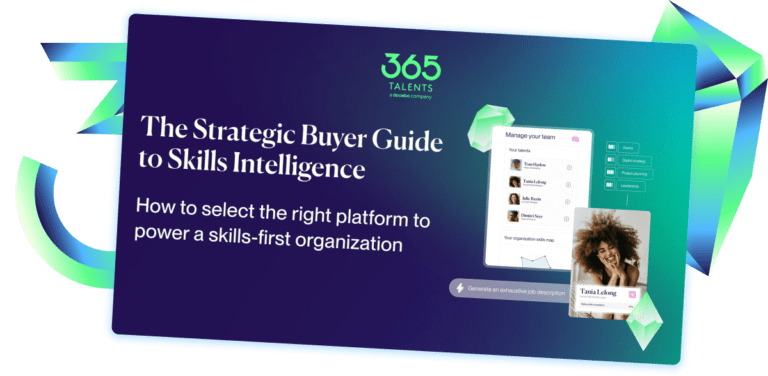
Want to buy a skills intelligence solution?
Download our dedicated guide to make the right choice!
Get your copy
Evaluation criteria for vendor comparison
| Criterion | What strong looks like |
| Skills ontology size and structure | Tens of thousands of skills, organized with relationships and proficiency levels, refreshed continuously |
| Inference accuracy | Validated against employee feedback, with confidence scores exposed |
| Languages supported natively | All major languages of operation, processed without translation degradation |
| Deployment time | Weeks to first value, not months |
| Integration coverage | Pre-built connectors for the HRIS, LMS, ATS, and collaboration tools in use |
| AI governance | Explainability, audit trails, EU AI Act readiness, employee data rights |
| Use case breadth | Supports workforce planning, mobility, learning, and reorganization, not just one of these |
Common mistakes when selecting an AI skills management tool
The three most common mistakes:
- Buying based on demo polish instead of ontology quality. A demo with curated data looks great. Real workforce data is messy. Ask to see the platform run on a sample of your actual employee data before deciding.
- Underestimating the multilingual problem. Vendors will claim multilingual support based on UI translation. Skills inference in multiple languages is a different and much harder problem.
- Treating AI skills management as a side project. Skills data becomes central to mobility, hiring, planning, and learning once you have it. Sponsorship needs to be at the CHRO level, not buried in a single function.
Key takeaways
- AI skills management tools fall into five categories: AI-native workforce intelligence, talent marketplaces with skills layers, HRIS-embedded modules, learning platforms with skills, and ATS platforms with extraction.
- Three dimensions separate real AI capability from AI labeling: responsible and explainable AI, deployment speed, and native multilingual support.
- The biggest predictor of deployment success is whether the ontology is pre-built and updates continuously, or whether the project starts with a long taxonomy-building phase.
- EU AI Act compliance and explainability are now baseline requirements for European operations.
- Sponsor the program at the CHRO level, because skills data becomes infrastructure for multiple HR processes once it exists.