Imagine joining a company five years ago. Your job was clear, your career path mapped. Today, half the tools you use didn’t exist, and many skills that once defined your value are already fading. This is not the future: it’s the new reality of work.
We live in a BANI workplace environment, brittle, anxious, nonlinear, and incomprehensible. In this context, static job descriptions and rigid career paths no longer work. Skills evolve faster than organizations can adapt, leaving employees and companies at risk of falling behind.
The solution? Job-readiness and workforce skills development—the ability to acquire, adapt, and apply new skills—has become the new currency of resilience.
The skills imperative for workforce-readiness
- By 2030, 39% of core skills will have changed (World Economic Forum).
- 67% of employees cite skill-building opportunities as a key reason to stay (PwC, 2024).
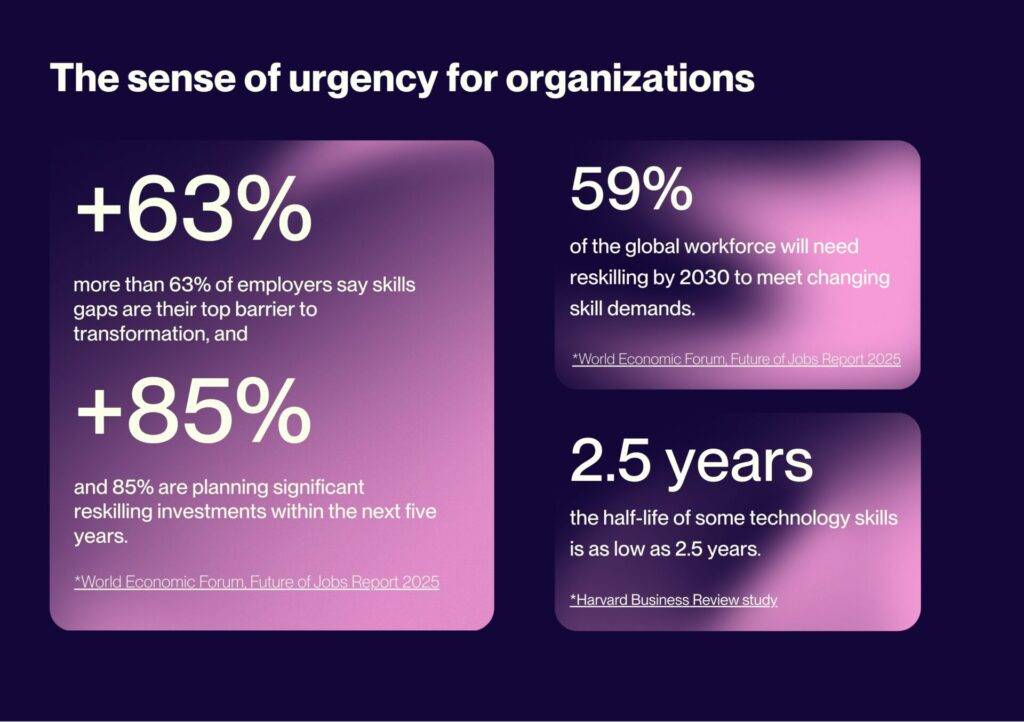
- 63% of employers report skills gaps as their top barrier to transformation, with 85% planning reskilling programs within five years (WEF Future of Jobs Report, 2025).
The message is clear: the future of work won’t wait. Companies that prioritize skills-based workforce planning and employability will not only survive, they will thrive.
From Job-First to Skills-First workforce strategy
Traditional approaches, job-first or people-first models, are no longer sufficient. Kathi Enderes, SVP Research at The Josh Bersin Company, explains:
“The job-centric model confines employees to static roles, while traditional talent management doesn’t focus on rapidly evolving skill requirements. AI can elevate every employee into a 'superworker,' but only if work is organized around skills, adaptability, and continuous learning.”
Job-readiness drives competitiveness and career longevity. Skills that were once anchors now fade before performance reviews are completed. Learn more in our Skills Impact Report!
A systemic approach built around skills velocity and dynamic work design—identifying, assessing, streamlining, and reengineering work tasks using AI—unlocks capacity and enables purpose-driven work.
The pace of skill change in the modern workplace
In technology fields, the “half-life” of a skill—the time it takes for half of what an employee knows to become obsolete—is now just 2.5 to 4 years. Every new tool, process, or AI capability reshapes what it means to be qualified.
Key trends in workforce skills development include:
- AI and automation skill demand outpacing other technical areas
- Rapid evolution of cybersecurity, data literacy, and digital literacy skills
- Growing emphasis on human skills like resilience, creativity, adaptability, and emotional intelligence
Job-readiness is no longer just an individual asset: it’s an organizational capability, combining:
- Skills and learning agility
- Intelligence and adaptability
- Flexible workforce design
- A culture that embraces change
Organizations with these capabilities can pivot, evolve, and remain relevant in volatile environments.
Turning BANI challenges into opportunities
BANI conditions (fragile systems, rising anxiety, nonlinear challenges) create unpredictability. But within volatility lies opportunity:
- The more unpredictable the world, the more valuable workforce agility and continuous learning become
- Job-readiness is the antidote to fragility: the ability to stay skilled, pivot, and evolve with purpose
Skills-first approach as a competitive advantage
Organizations that anticipate change, map emerging capabilities, and empower internal growth don’t just react: they reconfigure for success.
In a world where change is constant, skills are the only renewable resource. The question isn’t whether they’ll evolve, but whether organizations will evolve fast enough with them.
Macro forces, micro realities in skills development
Global skill trends
- Technical skills like AI, data literacy, and cybersecurity are in record demand
- Human skills such as resilience, creativity, adaptability, and emotional intelligence remain hardest—and most valuable—to develop
Regulatory and organizational impacts
- France: GEPP agreements make skills strategy a legal requirement, forcing organizations to balance cost control with employability
- Luxembourg: Skills‑Plang law enables companies to assess future skill needs and implement validated training plans
Skills management platforms are increasingly mandatory, providing structured tracking of employee growth and mobility. What was once an HR initiative has become central to business strategy.
Skills obsolescence: Threat or opportunity?
Skills fade, but how you respond defines the outcome.
- Ignoring obsolescence leads to disengagement, attrition, and missed opportunities
- Embracing it turns uncertainty into agility
Skills-based workforce planning empowers organizations to:
- Map emerging capabilities
- Reskill and upskill employees quickly
- Optimize internal mobility
- Build a future-ready, adaptive workforce
Replacing fear with skills and role reinvention
Continuous skill-building helps employees move beyond disappearing jobs. Skills are the new operating system of organizations:
- Enable faster reskilling and upskilling
- Support agile workforce planning
- Unlock smarter internal mobility
By putting skills at the center of workforce strategy, companies shift from defending outdated structures to designing adaptive, skills-driven systems.
Skills have become central to our career paths. They play a growing role in internal recruitment, performance evaluation, employee career support, and career development.
Actionable next steps: Make your workforce future-ready
The future of work favors the prepared. Start reinventing career paths and building job-readiness through skills.
Download our free Skills Impact Report to discover practical strategies, insights, and frameworks for creating a resilient, agile, and future-ready workforce.

Download our 2026 Skills Impact Report!
Job readiness unlocked: how to build a skills‑first, future-ready workforce
GET YOUR COPY