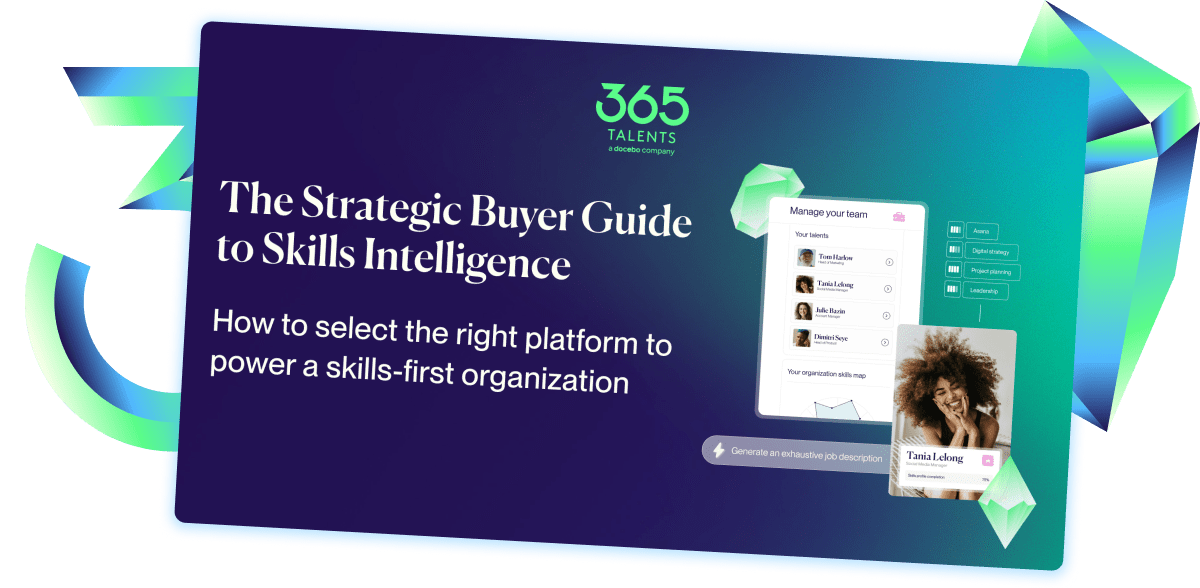
The Strategic Guide to Skills Intelligence
Organizations are redesigning around skills. Becoming truly skills-based requires a centralized layer of intelligence — one that maps capabilities, uncovers hidden potential, and connects decisions to business priorities. Download the guide today and:
- Understand the difference between basic tools and true Skills Intelligence
- Evaluate the 9 core capabilities that matter most
- Ask the right questions to vendors
- Access scoring templates and use case frameworks
- Learn from real-world implementation results
Select the right platform to power your skills-first organization, and turn workforce data into measurable business impact!
Industry leaders trust us












Skill needs evolve faster than organizations can adapt
Most organizations still manage their workforce around job titles and rigid hierarchies. Skill needs have outpaced the structures meant to manage them.
Where traditional models fall short:
× People defined by job titles, not what they can do
× Annual planning cycles that can’t keep pace with change
× External hiring compensates for internal visibility gaps
× Career growth gated by manager relationships, not merit
× Skills data scattered across systems with no unified view
× Hidden talent stays invisible, and untapped
What a skills-first approach unlocks
✓ Capabilities mapped continuously across the enterprise
✓ Career paths become dynamic and non-linear
✓ Internal talent mobilized before looking outside
✓ Workforce planning grounded in real-time intelligence
✓ More equitable and inclusive access to opportunity
The question is no longer whether to invest in skills intelligence — it’s which platform will actually deliver.
Download today and make the right choice according to your needs!
Download The Skills Intelligence Buyer Guide
The problems Skills Intelligence solves
A mature skills intelligence platform directly addresses the most persistent — and costly — HR challenges.
- Limited workforce visibility: HR teams can’t answer basic strategic questions: What skills do we have? Where are they concentrated? Which are emerging or declining?
- Reactive workforce planning: Most planning remains backward-looking. Skills intelligence enables scenario modeling and genuine forward visibility.
- Underutilized internal talent: Organizations hire externally for capabilities that already exist internally — but remain invisible without the right tools.
- Ineffective upskilling: Without granular skill data, L&D cannot prioritize the right development initiatives or measure their impact.

Where Skills Intelligence drives results
Organizations typically prioritize skills intelligence where it can drive immediate, measurable impact.
- Internal Mobility & Retention: Increase internal fill rates, Reduce external hiring costs, Strengthen engagement and retention
- Upskilling & Reskilling: Identify critical skill gaps, Deliver personalized learning journeys, Track progression over time
- Workforce Planning: Anticipate future skill needs, identify capabilities at risk, Inform hiring strategies
- Diversity & Inclusion: Reduce credential-based bias, Focus on demonstrated capabilities, Broaden access to opportunity

The 9 core capabilities to evaluate
Not every platform labeled “skills-based” delivers real intelligence. Here’s what to look for.
AI-powered skills inference
Automatically extracts skills from CVs, job descriptions, learning activity, and performance data — continuously updating profiles without manual input.
A living skills ontology
A normalized, evolving skills architecture that maps adjacencies, proficiency levels, and relationships across the entire enterprise.
Intelligent talent matching
Skills-based matching for roles, projects, mentorship, and learning — going beyond keywords to surface non-obvious, high-potential matches.
Predictive workforce intelligence
Scenario modeling, skill gap analysis, and risk forecasting to support strategic workforce decisions with confidence.
Seamless ecosystem integration
Native connections to HRIS, ATS, LMS, and performance systems — centralizing skills data while enabling action within existing workflows.
Ethical & responsible AI
Transparent, explainable recommendations with built-in bias detection mechanisms and full GDPR compliance.
Talent experience & adoption
Intuitive employee profiles, clear career visibility, and mobile + multilingual support to drive meaningful engagement.
Implementation & change management
Structured rollout in 8–16 weeks, with pilot phases, adoption planning, and executive alignment built into the methodology.
Measuring ROI
Clear metrics across internal fill rates, time-to-staff, hiring cost reduction, turnover, and upskilling effectiveness.
"Skills-first is both a mindset and an operational model — it requires dynamic visibility into capabilities, and the ability to actively use that intelligence to drive agility and unlock growth."

9 weeks
Average deployment time. Alstom went live across 55,000 employees in 63 countries

+30%
Increase in internal mobility as employees gain visibility into aligned opportunities

-25%
Reduction in external hiring costs through smarter redeployment and reskilling
Ready to choose the right Skills Intelligence platform?
A structured framework for making a confident, defensible choice. This guide walks you through what separates genuine skills intelligence from skills-adjacent tools — and gives you the questions, templates, and criteria to evaluate any platform on your shortlist.
-
Why traditional workforce models are failing: The structural gaps that make job-title-based management unsustainable
-
Basic tools vs. true skills intelligence: How to tell the difference — and why it matters for long-term ROI
-
9 core capabilities — with vendor questions ready to use: Probe depth, not just features, with questions designed to surface real gaps
-
High-impact use cases across mobility, planning, L&D, and D&I: Translate platform capabilities into business outcomes your stakeholders recognize
-
Capability scoring template: A ready-to-use framework for comparing vendors side by side
-
Case study: 55,000 employees, deployed in 9 weeks. How one organization achieved enterprise-scale skills intelligence — fast
-
Final vendor evaluation checklist: Everything to confirm before signing — organized for the last stage of your review
See how 365Talents compares on every dimension.
Talk to our team — we’ll walk through your specific use case!
