When a major workforce reorganization hits, HR needs a skills map of the affected population immediately. Not after a six-month deployment. Not after a survey campaign. Now.
Yet in most organizations, that skills map does not exist. What exists instead is an organizational chart. And organizational charts show reporting lines, not skills.
This is the fundamental disconnect in workforce transformation. Reorganizations are decisions about capabilities, but the data available to inform them is structural. The result: leadership makes reallocation choices based on hierarchy, seniority, and manager perception rather than on skills data that reflects what people can actually do.
Real case: a financial group uses skills data for cross-divisional restructuring
A financial group was preparing for a large-scale workforce reorganization spanning multiple divisions. The challenge was clear: decisions had to be made quickly, and leadership needed a reliable skills-based fact base to guide strategic workforce planning.
Traditional approaches would have required months of data collection: employee surveys, self-assessments, manager reviews, all of it feeding into a skills picture that would arrive long after restructuring decisions had been finalized. The organization did not have that time.
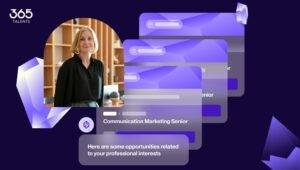
Using AI-powered Skills View by 365Talents, they activated existing HRIS data to build a cross-functional skills map in weeks. The platform connected directly to existing HR systems across divisions, bringing together skills data, job data, and people data into a single, unified workforce intelligence layer.
No employees were asked to participate. No surveys were launched. No new platform was deployed.


What skills-based workforce planning makes possible
The skills map changed the nature of the strategic workforce planning conversation. Instead of debating who should go where based on titles and reporting lines, leadership could evaluate reallocation options against real skills data.
- Tactical workforce planning across divisions became possible for the first time. HR could see supply and demand for critical skills at a granular level, across business units that had never been compared before.
- Skills gap analysis and skills matrix revealed where redundancies existed and where capabilities were at risk. Some teams had significant skill overlaps that no one had quantified. Others had single points of failure in critical competency areas.
- Scenario modeling for workforce transformation allowed leadership to test different reallocation options before committing. Rather than making irreversible decisions in the dark, they could simulate outcomes against the actual skills landscape.
- Cross-functional skills mapping surfaced hidden overlaps and transferable competencies between teams that had never been compared before. Employees with strong skill matches to roles in other divisions became visible for the first time.
Skills-based restructuring: from organizational boxes to capability clusters
The shift was concrete. Instead of reorganizing based on hierarchy, the organization reorganized based on actual capabilities identified through skills data.
This changed the quality of workforce transformation decisions in several ways.
- Risk was reduced because reallocation choices were grounded in skills-based evidence.
- The likelihood of placing someone in a role they could not perform dropped significantly.
- Cross-functional talent that would have been invisible in an organizational chart view became available for reassignment.
- Leadership gained confidence that their choices were defensible.
In restructuring contexts, where decisions are scrutinized internally and sometimes externally, having a skills-based fact base makes a measurable difference.

Speed as a competitive advantage in workforce transformation
Perhaps the most important factor was timing. With Skills View by 365Talents, the skills map was available in weeks, not the 6 to 12 months that a traditional skills assessment approach would have required.
This speed is not just a convenience, in workforce reorganization contexts, it is a competitive advantage. Decisions that are delayed cost the organization in uncertainty, productivity loss, and talent attrition. The faster HR can provide a reliable skills-based fact base, the faster leadership can act with confidence.
The reorganization was completed on schedule, informed by skills data that would otherwise have arrived too late to be useful.
Key takeaway: skills data should guide reorganization decisions
Organizational charts remain essential, but they are not enough. Workforce reorganization requires a view of what people can actually do.
If your organization is facing a restructuring, a site consolidation, or a merger integration, the question is not whether you need skills data. It is whether you can afford to wait months to get it.
Stop reorganizing boxes. Start reorganizing what people can do.