Organizations today are facing a new workforce reality.
Technology evolves at breakneck speed, market priorities shift constantly, and the half-life of many digital skills is shrinking dramatically. In this environment, traditional workforce planning approaches are struggling to keep up.
For decades, organizations have relied on job descriptions, hiring plans, and training programs to prepare their workforce for the future. But today, these models are proving too rigid for a world defined by rapid change.
The result is a growing workforce readiness gap.
According to research cited in the report Skills + Learning: The Playbook to Workforce Readiness, skill mismatches cost the global economy up to $18 trillion in unrealized GDP each year.
For HR leaders, the implications are clear: organizations must rethink how they define, build, and mobilize capability.
Increasingly, the answer lies in shifting from job-based workforce planning to skills-based strategies powered by skills intelligence.
The workforce readiness crisis
Workforce readiness has become a critical issue for organizations across industries.
Many companies report that skill gaps are now the number one barrier to business transformation.
At the same time, employees are experiencing increasing pressure to keep up with continuous change. New tools, new technologies, and new ways of working emerge faster than traditional learning programs can adapt.
This challenge is often described using the BANI framework, which characterizes today’s environment as:
- Brittle: systems break when conditions change
- Anxious: constant disruption creates uncertainty
- Nonlinear: small changes can produce large, unpredictable outcomes
- Incomprehensible: the signals organizations rely on are increasingly difficult to interpret
In such a landscape, workforce readiness is no longer about filling open roles. It’s about building adaptable capability across the organization.
And that requires a new way of thinking about talent.


Why job-based Workforce Planning is becoming obsolete
Traditional workforce models revolve around jobs.
Organizations define roles, hire people to fill them, and train employees according to their job description. This approach worked well in a more stable business environment.
But today, roles evolve faster than job architectures can keep up.
A recent example illustrates this shift clearly.
In 2023, prompt engineering was widely described as one of the most promising new careers in artificial intelligence. Companies rushed to hire prompt engineers, often offering extremely high salaries.
Within just a few years, the role itself largely disappeared.
The skill didn’t vanish—it simply spread across the workforce. Marketers, developers, analysts, and product managers now use AI prompting in their everyday tasks.
This shift highlights a critical lesson:
Capabilities evolve faster than job titles.
Organizations that continue to plan their workforce around static roles will constantly struggle to keep pace with change.
Instead, forward-thinking companies are beginning to treat skills—not jobs—as the fundamental unit of workforce capability.
Why traditional Learning Programs aren’t solving skill gaps
In response to growing skill gaps, many organizations have increased their investment in learning and development.
Employees now have access to extensive training libraries, certifications, digital learning platforms, and internal academies. Participation in learning programs is higher than ever.
Yet skill shortages persist.
The problem isn’t a lack of learning activity—it’s the disconnect between learning and workforce capability.
Most organizations still measure learning using activity-based metrics such as:
- Course completions
- Hours spent learning
- Training participation rates
While these indicators are easy to track, they don’t answer the questions that matter most to business leaders:
- Which critical skills are we actually building?
- Are employees applying those skills in real work?
- Do these capabilities already exist somewhere else in the organization?
- Are we preparing for the skills we’ll need next year—not just today?
Without connecting learning to real business outcomes, training risks becoming disconnected from workforce readiness.
The rise of Skills Intelligence
To close the gap between learning and workforce capability, organizations need a way to understand skills dynamically across the enterprise.
This is where skills intelligence comes in.
Skills intelligence uses data and artificial intelligence to identify, track, and mobilize skills across the organization.
Rather than relying solely on static job descriptions or self-reported skills, AI can analyze multiple signals, including:
- learning activity
- work outputs
- performance data
- collaboration patterns
- project experience
From these signals, organizations can build a dynamic, real-time view of workforce capability.
This visibility unlocks new possibilities for workforce planning.
Instead of reacting to skill shortages, leaders can:
- identify emerging skill demands early
- uncover hidden talent within the workforce
- guide targeted learning investments
- accelerate internal mobility
- redeploy capability as priorities shift
In short, skills intelligence transforms skill data into strategic insight.
How AI is transforming Workforce Readiness
Artificial intelligence plays a critical role in making skills intelligence scalable.
In large organizations, thousands of employees generate enormous volumes of learning, performance, and work data. Without AI, interpreting these signals would be nearly impossible.
AI can automate several key capabilities, including:
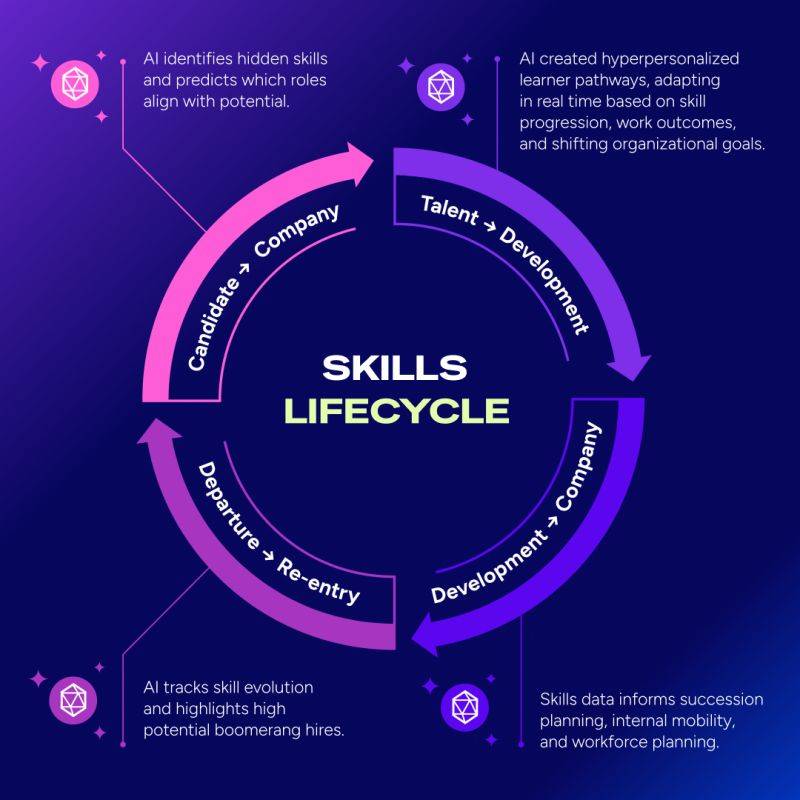
1. Inferring skills automatically
Rather than relying solely on self-declared profiles, AI can infer skills based on learning behavior, project work, and performance outcomes.
This helps reveal hidden skills that might otherwise go unnoticed.
2. Hyperpersonalizing learning pathways
AI can tailor development opportunities based on an employee’s current skills, career trajectory, and organizational priorities.
Instead of generic training programs, employees receive highly relevant learning recommendations.
3. Adapting development in real time
As skills evolve or business priorities change, AI can automatically adjust learning pathways and development plans.
This ensures that workforce development remains aligned with organizational strategy.
Workforce readiness goes beyond employees
Another major shift in workforce strategy is recognizing that capability development extends beyond internal employees.
Organizations increasingly rely on a broader ecosystem that includes:
- customers who must successfully adopt products
- partners who represent the brand in the market
- contractors who need to become productive quickly
If these groups lack the necessary knowledge or capabilities, the business impact can be significant.
For example:
- customers may struggle to extract value from products
- partners may fail to represent solutions effectively
- contractors may require extensive onboarding before becoming productive
By extending skills intelligence and learning to this wider ecosystem, organizations can ensure that everyone contributing to value creation has the capabilities they need.
Turning Skills Intelligence into action: The role of integrated platforms
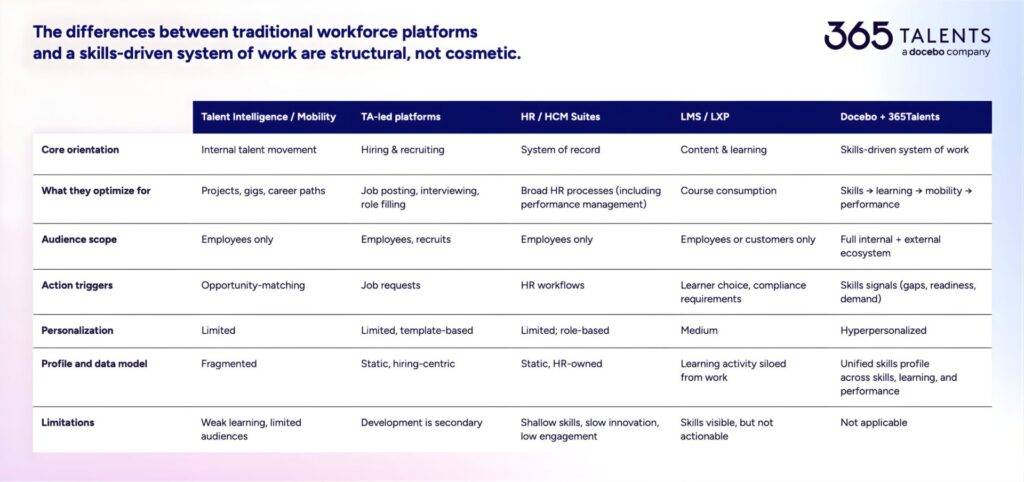
While the concept of skills intelligence is gaining traction, many organizations still struggle with a practical challenge: operationalizing skills across learning, talent, and workforce decisions.
In many companies, the technology landscape remains fragmented. HR platforms manage employee records, learning platforms deliver training, and talent systems support hiring or internal mobility. Each tool generates valuable data, but the signals remain disconnected.
As a result, organizations often face familiar challenges:
- Skills are identified but not actively developed
- Learning programs exist but aren’t aligned with real capability gaps
- Internal talent is overlooked because skills remain hidden in siloed systems
- Workforce decisions rely more on job titles than actual capabilities
To truly support workforce readiness, organizations need a shared skills foundation that connects learning, development, and workforce execution.
This is the vision behind the combined approach of Docebo and 365Talents.
Together, the two platforms aim to create an AI-driven system where skills data flows continuously between learning and talent intelligence.
A unified Skills Profile
One of the core elements of this approach is a unified skills profile.
Instead of storing skills in separate systems, organizations can bring together signals from learning activity, performance data, and real work outcomes into a single view of workforce capability.
This unified perspective helps leaders answer critical questions such as:
- Which skills already exist inside the organization?
- Where are capability gaps emerging?
- Which employees have adjacent or hidden skills that could be mobilized?
By making skills visible, organizations gain the ability to activate talent that might otherwise remain undiscovered.
Connecting Learning to real work
Another key element is closing the gap between learning and application.
In a skills-driven system, skill gaps can trigger targeted learning opportunities automatically. AI can recommend development pathways tailored to each individual’s capabilities and career trajectory.
As employees apply new skills in their work, proficiency can be validated and development paths updated accordingly.
This creates a continuous loop: skills signals → learning → real work outcomes → updated skill insights. Instead of treating learning as a separate activity, development becomes embedded in how work happens.
Hyperpersonalized development at acale
AI also enables a level of personalization that traditional training programs struggle to achieve.
Rather than assigning courses based on job roles alone, learning pathways can adapt to each individual’s:
- existing skills
- adjacent capabilities
- career goals
- current work context
As priorities shift, development pathways adjust automatically, ensuring that workforce capability evolves alongside business strategy.
A shared skills foundation across the ecosystem
Finally, skills intelligence can extend beyond internal employees.
Organizations increasingly need visibility into the capabilities of partners, customers, and external contributors who play a role in delivering value.
By capturing skills data across this broader ecosystem, organizations can ensure that everyone involved—from internal teams to partners in the field—has access to the knowledge and capabilities needed to succeed.
From skills insight to workforce execution
Ultimately, the goal of skills intelligence isn’t just to identify skill gaps.
It’s to connect skills, learning, and work execution into a continuous cycle.
In a skills-driven system:
- Skill gaps are identified through workforce data
- Targeted learning opportunities are delivered automatically
- Employees apply those skills in real work
- Performance outcomes validate and refine capability development
This creates a self-reinforcing loop where workforce capability continuously evolves alongside business priorities.
The Future of Workforce Strategy
Organizations have never had more data about their workforce. Yet many still struggle to translate that information into better decisions about talent, development, and capability.
The next generation of workforce strategy will focus on making skills visible, actionable, and connected to how work actually happens. In a world defined by rapid technological change, organizations cannot rely on static roles or traditional planning cycles.
Instead, they must build systems that continuously interpret skill signals and adapt accordingly. Because ultimately, workforce readiness isn’t about hiring more people or offering more courses.It’s about understanding the capabilities within your organization—and mobilizing them faster than change itself.