Workforce planning has entered a new reality.
Organizations today operate in a world that feels increasingly brittle, anxious, nonlinear, and incomprehensible. Technology evolves faster than job descriptions, strategic priorities shift mid-year, and skills become obsolete almost as quickly as they appear.
In this environment, traditional workforce planning methods simply don’t hold up.
The problem isn’t a lack of training programs, HR platforms, or data. Companies already have plenty of those. The real issue is that learning, skills, and work are still disconnected.
To build true workforce readiness, organizations must rethink how they understand capability, and place skills intelligence at the center of how work gets done.
Workforce readiness is breaking
The cost of workforce readiness gaps is staggering.
Globally, skill mismatches are estimated to cost the economy up to $18 trillion in unrealized GDP each year.
At the organizational level, the impact is just as visible:
- Skill gaps slow down transformation initiatives
- Teams struggle to adapt when priorities change
- Burnout and disengagement increase as employees try to keep up with constant change
- Innovation slows because organizations lack the capabilities needed to execute strategy
Many companies try to solve this problem by hiring more people or investing in more training.
But neither approach addresses the real issue: the way organizations define capability is outdated.


Why job-based thinking no longer works
For decades, workforce planning has revolved around jobs.
Job titles determine hiring plans, training programs, career paths, and organizational structure. The assumption behind this model is stability: that roles and responsibilities change slowly enough for organizations to plan around them.
Today, that assumption is no longer valid.
Consider the rise of prompt engineering. In 2023, it was widely promoted as the “job of the future.” Companies rushed to hire specialized prompt engineers at high salaries.
Just two years later, the role had largely disappeared.
The skill didn’t vanish—it spread across the workforce. Marketers, developers, product managers, and analysts now use AI prompting in their daily work.
This example highlights a fundamental shift:
Capabilities evolve faster than job structures.
Organizations that organize work around fixed roles will constantly be chasing change. Those that organize around skills can adapt in real time.
The limits of traditional Learning Programs
Most organizations already invest heavily in learning.
They offer training libraries, certifications, internal academies, and digital learning platforms. Employees are completing more courses than ever before.
Yet skill gaps remain the number one barrier to business transformation.
Why?
Because most learning programs measure activity rather than impact.
Typical metrics include:
- Course completions
- Hours spent learning
- Participation rates
While useful, these indicators don’t answer the most important questions leaders face:
- Are we building the skills our strategy requires?
- Are those skills being applied to real work?
- Do these capabilities exist somewhere else in the organization already?
Without connecting learning to workforce capability and execution, training remains disconnected from business outcomes.
Skills Intelligence: The missing link
To close this gap, organizations need a way to understand skills dynamically across the enterprise.
This is where skills intelligence comes in.
Skills intelligence turns skill data into actionable insights about how work is evolving and where capability exists.
Instead of treating skill gaps as problems to fill, leading organizations treat them as signals.
Signals that reveal:
- Emerging areas of demand
- Hidden talent already present in the workforce
- Opportunities for internal mobility
- New development priorities
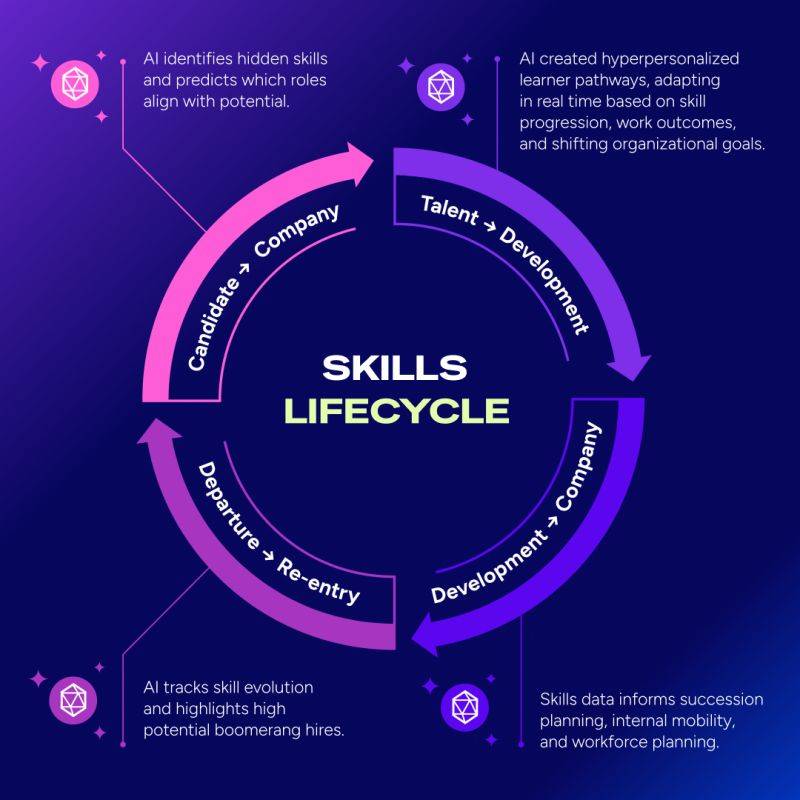
With the help of AI, organizations can now interpret these signals at scale.
AI can infer skills from learning activity, work outputs, and performance data. As gaps emerge, it can recommend targeted development opportunities and adapt learning pathways automatically.
For employees, this means less irrelevant training and more meaningful development.
For leaders, it means real visibility into organizational capability.
Workforce readiness goes beyond employees
Another limitation of traditional talent strategies is that they focus exclusively on employees.
But workforce readiness today extends far beyond internal teams.
Organizations rely on a broader ecosystem that includes:
- Customers who must adopt products successfully
- Partners who represent the brand and sell solutions
- Contractors who must become productive quickly
Each group requires access to the right knowledge and capabilities.
Skills intelligence makes it possible to extend learning and capability development across this entire ecosystem—ensuring that everyone contributing to value creation is equipped to succeed.
The shift toward skills-based organizations
When organizations move from job-based thinking to skills-based execution, several things change.
Projects are staffed based on capability, not titles.
Learning becomes personalized and continuous, adapting as skills evolve.
Workforce planning becomes more agile, allowing leaders to redeploy talent quickly when priorities shift.
The result is a more responsive and resilient organization.
Research shows that skills-based organizations also experience significantly higher retention among high-performing employees, reinforcing the link between capability development and engagement.
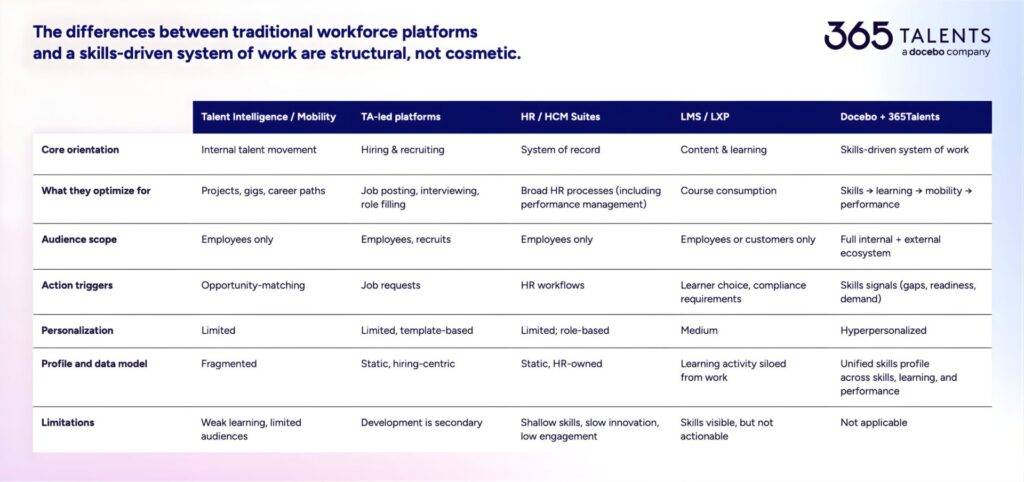
Turning Skills Insight Into Action
Ultimately, workforce readiness requires more than identifying skill gaps.
It requires connecting three critical elements:
Skills → Learning → Work execution
When these elements are integrated:
- Skill gaps trigger targeted learning opportunities
- Development is tailored to each individual’s capabilities and context
- Skills are validated through real work outcomes
- Workforce planning adapts as capabilities evolve
This creates a virtuous cycle where learning drives capability, capability improves execution, and execution informs future development.
The future of workforce readiness
Organizations have never had more technology to manage their workforce.
Yet many still struggle to translate all that data and activity into better outcomes.
The next generation of workforce strategies will focus on making skills visible, actionable, and connected to how work actually happens.
Because in a world where change is constant, the organizations that thrive won’t be the ones with the most training programs or the largest talent pools.
They’ll be the ones that understand their skills ecosystem—and can mobilize it faster than everyone else.